As an experienced residential surveyor specializing in non-standard construction properties across England and Wales, I've surveyed everything from 1950s concrete houses to modern timber frame homes. Unusual construction methods present unique challenges for buyers, surveyors, mortgage lenders, and insurers - but with proper expertise and understanding, these properties can be excellent purchases.
This comprehensive guide explains the most common types of unusual construction, what to look for during surveys, how to secure mortgages and insurance, and realistic advice on whether these properties represent good value or potential problems.
What is Non-Standard Construction?
"Non-standard" or "unusual" construction refers to any property not built using traditional brick/block cavity wall construction with a pitched roof and timber floors. These properties require specialist surveyor knowledge and often face lending and insurance challenges.
Why It Matters
- Mortgage restrictions - Many lenders refuse or limit lending on non-standard properties
- Insurance difficulties - Higher premiums or specialist insurers required
- Resale challenges - Smaller buyer pool affects future saleability
- Specialist surveys needed - Standard surveyors may lack expertise
- Repair complications - Specialist contractors and materials required
Common Types of Unusual Construction
1. Concrete Construction (Post-War Prefabricated)
Built primarily 1945-1970 to address post-war housing shortages. Several types exist with varying characteristics:
PRC (Pre-cast Reinforced Concrete)
- Years built: 1945-1960s
- Identification: Large concrete panels, often rendered, visible panel joints
- Common types: Airey, Wimpey No-Fines, Cornish Unit, Reema, Unity
- Key issues: Concrete degradation, steel reinforcement corrosion, carbonation
- PRC Homes designation: Some types officially designated as defective
Mortgage availability: Very limited - many designated types un-mortgageable unless repaired with PRC certificate
Repair status critical: Properties with PRC Homes repair certificates acceptable to more lenders
Survey requirement: Specialist PRC surveyor essential
System-Built Concrete
- Examples: Reema, Unity, Wates
- Characteristics: Prefabricated concrete panels, factory-made, site-assembled
- Condition varies: Some excellent, others severely deteriorated
- Survey focus: Panel joints, concrete condition, waterproofing, movement
2. Timber Frame Construction
Increasingly common, especially in new builds. Two main eras:
1960s-1980s Timber Frame
- Concerns: Early designs had moisture and durability issues
- Key risks: Water penetration causing timber decay, cavity barriers inadequate
- Notable: Some NHBC warranty exclusions for pre-1980s timber frame
- Mortgage: Some lenders cautious about pre-1990s timber frame
Modern Timber Frame (1990s onwards)
- Improved standards: Better moisture barriers, breathing membranes, quality control
- Identification: Often difficult - external appearance like standard brick
- Survey approach: Check building control certificates, NHBC documentation
- Mortgage: Generally acceptable to most lenders if post-1990
Survey essentials: Moisture ingress detection, structural timber inspection, cavity inspection where possible
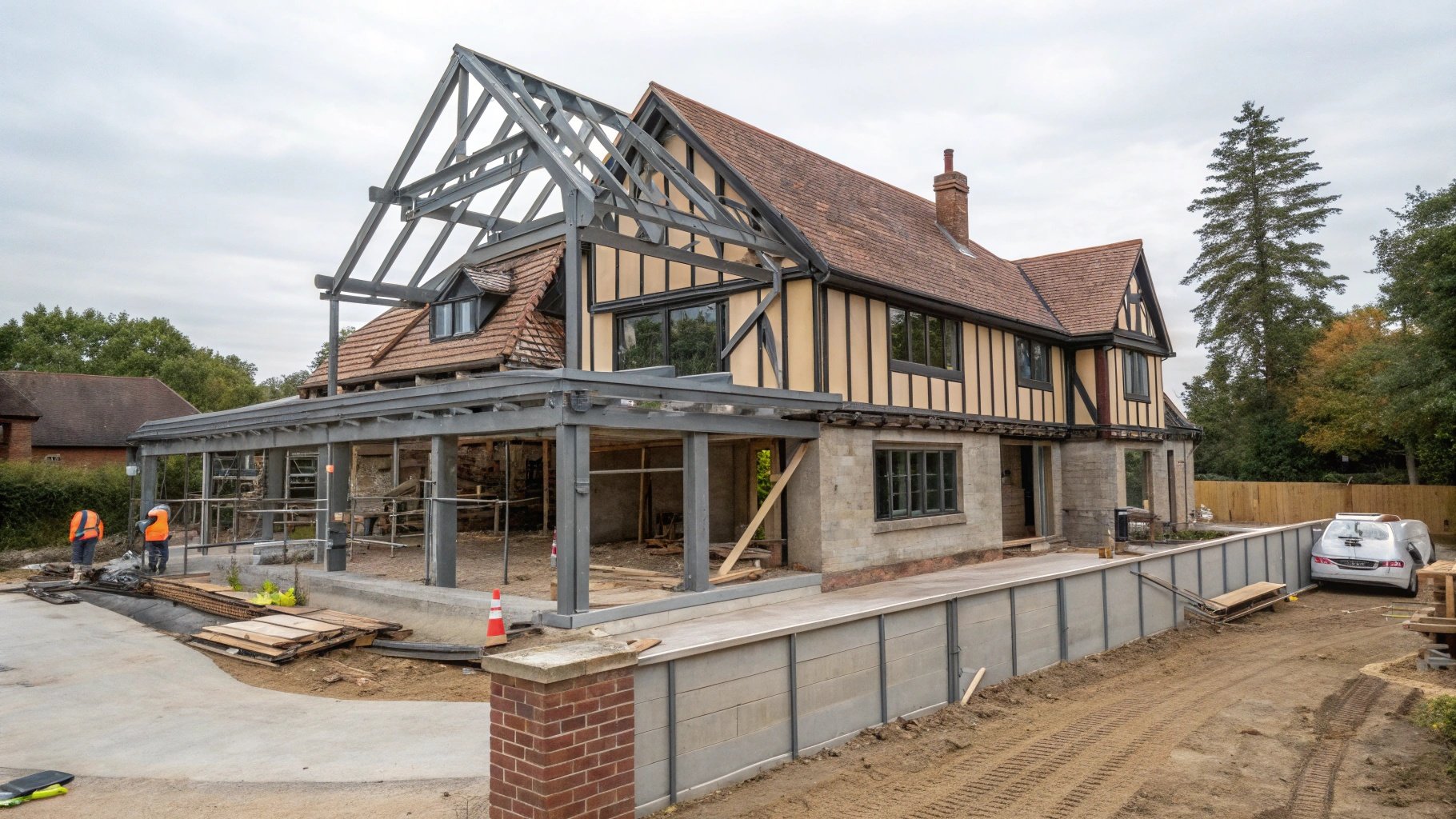
3. Steel Frame Construction
British Iron and Steel Federation (BISF) Houses
- Built: 1945-1950s
- Recognition: Distinctive Art Deco styling, flat roofs often added later
- Structure: Steel frame with concrete panels or brick infill
- Issues: Steel corrosion, inadequate insulation, flat roof problems
- Mortgage: Limited availability, some lenders acceptable with engineer's certificate
Modern Steel Frame
- Usage: Increasingly common in contemporary builds
- Benefits: Speed of construction, design flexibility, durability
- Mortgage: Generally acceptable to mainstream lenders
- Survey focus: Connections, fire protection, corrosion protection
4. Other Non-Standard Types
Thatched Properties
- Specialist insurance: Essential - fire risk, higher premiums
- Maintenance: Re-thatching every 15-25 years (£15,000-£30,000)
- Survey specialist: Thatch surveyor recommended alongside building survey
- Mortgage: Available but specialist lenders often required
Cob and Earth Construction
- Traditional: Common in Devon, Cornwall, parts of Wales
- Characteristics: Thick walls (500mm+), lime-based, breathable
- Critical: Must breathe - impermeable renders/paints cause failure
- Survey: Specialist with earth construction knowledge essential
- Mortgage: Specialist lenders only, often require conservation reports
Modular and SIPs (Structural Insulated Panels)
- Modern: Factory-built modules or panels
- Benefits: Energy efficient, quick construction
- Considerations: Long-term performance data limited
- Mortgage: Improving acceptance, mainstream lenders increasingly comfortable
Essential Survey Considerations
Why Standard Surveys Aren't Enough
Non-standard construction requires specialized knowledge:
- Construction-specific defects - Each type has unique failure modes
- Deterioration patterns - Understanding how materials age and fail
- Repair methods - Appropriate remediation for each construction type
- Future liabilities - Assessing long-term maintenance and costs
- Lender requirements - Understanding what lenders need to see
Choosing the Right Surveyor
Essential criteria:
- RICS qualified (MRICS/FRICS) - Non-negotiable professional standard
- Specific non-standard experience - Ask how many similar properties surveyed
- Knowledge of your property type - PRC, timber frame, steel frame specialist
- Local area knowledge - Familiarity with local construction types
- Lender/insurance understanding - Knows what documentation is required
Questions to Ask Your Surveyor
- "Have you surveyed [specific construction type] properties before?"
- "How many [PRC/timber frame/steel frame] properties have you inspected?"
- "What specific issues do you look for with this construction type?"
- "Will you provide documentation suitable for mortgage lenders?"
- "Do you recommend any additional specialist inspections?"
Survey Costs for Non-Standard Properties
Expect to pay premiums for specialist expertise:
- Standard property Level 3: £800-£1,200
- Non-standard property Level 3: £1,000-£1,800
- Premium: 20-40% additional for specialist knowledge
- Additional reports: Structural engineer (£500-£1,500), specialist thatch surveyor (£300-£600)
Mortgage and Insurance Challenges
Mortgage Availability by Construction Type
| Construction Type | Lender Acceptance | Special Requirements |
|---|---|---|
| PRC (designated defective) | Very Limited | Repair certificate essential |
| PRC (repaired with certificate) | Moderate | Valid repair certificate required |
| Timber frame (pre-1990) | Limited | Detailed survey, some lenders refuse |
| Timber frame (post-1990) | Good | Building Control certificates helpful |
| BISF steel frame | Limited-Moderate | Engineer's certificate often required |
| Modern steel frame | Good | Standard documentation sufficient |
| Thatched | Moderate | Specialist insurance confirmed |
| Cob/Earth | Limited | Specialist lenders, conservation reports |
Securing a Mortgage
Step-by-step approach:
- Research lenders early - Before making offers, identify willing lenders
- Use specialist brokers - Mortgage brokers with non-standard property experience
- Obtain detailed survey - Comprehensive report addressing lender concerns
- Gather documentation - Building Control certificates, NHBC certificates, repair certificates
- Consider higher deposits - Some lenders require 15-25% deposits vs. 10% standard
- Structural engineer reports - If surveyor recommends, commission before mortgage application
Insurance Considerations
Non-standard construction affects buildings insurance:
- Standard insurers: Many refuse or heavily restrict non-standard properties
- Specialist providers: Required for most unusual construction types
- Premium increases: Typically 20-50% higher than standard construction
- Higher excesses: £500-£1,000 vs. £250-£500 standard
- Exclusions: Some defects or failure modes may be excluded
Getting quotes: Obtain insurance quotes BEFORE exchanging contracts - mortgage offers are conditional on buildings insurance.
Should You Buy Non-Standard Construction?
Advantages
- Lower purchase prices - 10-30% below equivalent standard construction
- Less competition - Fewer buyers means better negotiating position
- Unique character - Distinctive architectural features
- Modern types - Often superior energy efficiency (timber frame, SIPs)
- Location benefits - May be only option in desirable areas
Disadvantages
- Limited mortgage choice - Fewer lenders, potentially higher rates
- Insurance difficulties - Higher costs, specialist providers
- Resale challenges - Smaller buyer pool when selling
- Specialist repairs - More expensive, fewer contractors
- Unknown longevity - Some types' long-term performance uncertain
When to Proceed
Non-standard construction can be excellent value if:
- Mortgage confirmed available - Lender agreed in principle before offer
- Insurance quotes obtained - Confirmed cover available at acceptable cost
- Specialist survey favorable - Expert assessment shows good condition
- Price reflects challenges - Discount compensates for restrictions
- Long-term ownership intended - Planning to stay 10+ years reduces resale concerns
- Repair certificates exist - For designated defective types
When to Walk Away
- No mortgage available - Unless buying cash and comfortable with restrictions
- Insurance refused - Multiple insurers decline cover
- Severe deterioration - Extensive repairs needed exceeding discount
- No repair certificate - For designated defective types requiring one
- Unknown construction type - Cannot identify or assess properly
Frequently Asked Questions
How do I know if a property is non-standard construction?
Several ways to identify unusual construction: 1) Estate agent details often mention "concrete construction" or "timber frame", 2) Visual clues - panel joints, unusual external appearance, distinctive styling (BISF houses), 3) Building age - properties 1945-1970 most likely, 4) Vendor disclosure on TA6 form, 5) EPC may note construction type, 6) Ask your surveyor to specifically identify construction method. As a residential surveyor, I always determine construction type early in inspection - it fundamentally affects the survey approach and what I look for. If you suspect non-standard construction, commission a Level 3 survey from a specialist surveyor experienced with unusual types.
Can I get a mortgage on a PRC property?
It depends on the specific PRC type and repair status. Properties designated as "defective" under the Housing Defects Act require repair certificates to be mortgageable - without certificates, mainstream mortgages are unavailable. Repaired PRC properties with valid certificates from approved schemes (PRC Homes Ltd) are acceptable to some specialist lenders, though choice is limited. Expect higher deposits (15-25%), potentially higher interest rates, and more stringent surveys. Some PRC types not officially designated as defective have better mortgage availability. Work with specialist mortgage brokers experienced in non-standard construction. Always confirm mortgage availability BEFORE making offers on PRC properties.
Are timber frame properties as good as brick construction?
Modern timber frame (post-1990) can be excellent - often superior energy efficiency, faster construction, and design flexibility compared to traditional brick. Current building regulations ensure proper moisture barriers, structural integrity, and durability. Issues primarily concern pre-1990s timber frame where moisture ingress caused timber decay in some properties. As a chartered surveyor, I assess timber frame properties based on age, construction quality, and condition. Modern timber frame from reputable developers with NHBC warranties offers comparable or superior performance to brick. Key is proper construction and maintenance - moisture control is critical. Pre-1990s timber frame requires careful specialist survey to assess condition. Most lenders now accept modern timber frame readily.
Will I lose money when I sell a non-standard property?
Not necessarily, but resale can be more challenging. Non-standard properties typically appreciate at 70-90% of standard construction rates - you'll build equity but potentially slower than conventional properties. The smaller buyer pool (many excluded by mortgage restrictions) means longer marketing periods and potentially lower offers. However, buying below market value initially often compensates. If you buy a non-standard property at 15-20% discount, slower appreciation may still leave you in good position. Factors affecting resale: construction type (modern timber frame easier than PRC), condition (well-maintained properties sell better), location (desirable areas have more willing buyers), and repair certificates (essential for designated types). Plan for longer ownership periods (10+ years) to allow equity building.
Should I commission a structural engineer report?
For many non-standard properties, yes. Your RICS building surveyor will recommend if needed. Structural engineer reports (£500-£1,500) provide detailed analysis of: structural integrity, specific construction type assessment, repair specifications if needed, and documentation satisfying lenders. Essential for: designated defective PRC types, BISF steel frame houses, pre-1990 timber frame showing concerns, concrete construction with visible deterioration, any property where surveyor identifies structural concerns. Engineers use specialized testing and calculations beyond typical surveying scope. Many lenders require engineer reports for certain construction types before mortgage approval. Commission after building survey if surveyor recommends - this avoids unnecessary expense if survey reveals deal-breaker issues first.
Conclusion: Expert Assessment is Essential
Non-standard construction properties can offer excellent value for informed buyers who understand the challenges and obtain proper professional advice. The keys to successful purchase are specialist surveyor expertise, confirmed mortgage availability, and realistic expectations about ownership and eventual resale.
Key takeaways:
- Identify construction type early - Before making offers
- Use specialist surveyors - Standard surveyors often lack necessary expertise
- Confirm lending before offering - Mortgage availability varies significantly
- Obtain insurance quotes - Essential before legal commitment
- Expect discounts - 10-30% below standard construction justified
- Plan long-term ownership - Reduces resale concerns
- Budget for specialist repairs - Higher costs than standard construction
As a residential surveyor specializing in unusual construction, I recommend always commissioning comprehensive Level 3 building surveys for non-standard properties. The additional cost (£1,000-£1,800) provides essential protection when buying properties that inherently carry higher risks than standard construction.
Need a Specialist Survey for Non-Standard Construction?
Our experienced RICS chartered surveyors have extensive expertise surveying unusual construction properties including PRC, timber frame, steel frame, and traditional non-standard types across England and Wales.
Request Specialist Survey Quote View Survey Services